Act One, No Bangers: How Pop Tours Became Three-Act Movies You Can't Skip
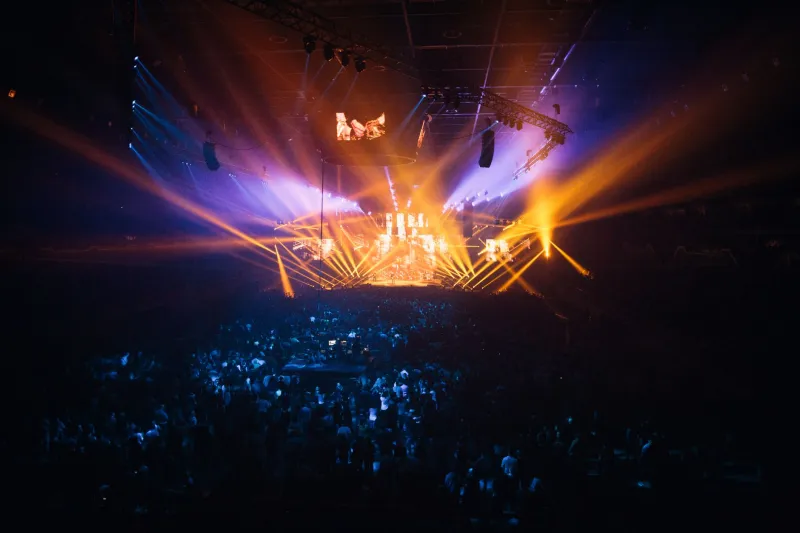
There was a time — not even that long ago — when a pop show was basically a really expensive playlist. Open with the banger, stack the hits, save the biggest one for the encore, go home. Everyone knew the formula. Nobody questioned it.
That era is over. Walk into an arena tour in 2025 and you're not getting a concert. You're getting a movie with a runtime, character development, and a plot twist nobody saw coming until someone's phone hit the For You page.
The Shuffle Era Is Officially Embarrassing
Ask any music director working a major pop tour right now and they'll tell you the same thing: the setlist stopped being a list and became a script.
The modern structure looks almost theatrical. There's an overture — often an instrumental or a deep cut that signals this show has a thesis. Then Act One, usually the moodier material, the world-building. An intermission or costume-change interlude that functions like a chapter break. A second act that escalates. And a finale engineered to feel like catharsis, not just a big singalong.
The hits are still there. They're just no longer the point. They're load-bearing walls inside a story about, say, heartbreak, reinvention, or whatever era the artist is currently inhabiting. Playing the singles in album order? That reads as lazy now. Playing them out of order, rearranged, stripped down or stitched into a suite — that's the flex.
"We stopped thinking about what people want to hear and started thinking about what they need to feel, and in what order," one longtime tour music director told us, speaking on condition of anonymity because, well, tour NDAs are real. "The setlist gets storyboarded like a film. Some nights we argue for an hour over whether one song goes in slot eleven or slot fourteen. Slot matters."
The Setlist Detectives
Here's where it gets fun: the fans are keeping score.
There's a whole ecosystem of superfans — call them setlist detectives — who track every night of a tour like box scores. Sites and spreadsheets document which songs got swapped, which got added, which got cut. When a pop star rotates a surprise song slot nightly, it turns every single show into a lottery ticket. Fans aren't just attending anymore; they're speculating.
This is the genius of the model. A fixed setlist is a product. A rotating one is a narrative with weekly episodes. The discourse between shows — "she pulled out the debut album deep cut in Chicago, are we entering a nostalgia act?" — keeps a tour trending for months without a single dollar of ad spend.
And when a surprise song choice is unexpected enough? It doesn't just trend that night. It can dominate an entire week of TikTok. A stripped-down performance of an old album track, filmed on seventeen thousand phones from slightly different angles, becomes the week's main character. Fans dissect the lyric emphasis. Editors sync it to movie clips. Someone makes a 45-second vertical edit that outperforms the official music video. The song choice becomes the content.
Why the Arc Works
Part of this is pure economics. If every show promises something unrepeatable, every show sells. The night you skip is always the night the surprise happens — ask anyone who sat out a tour stop only to watch the clip the next morning with the expression of someone who missed the group chat's best night.
But it's also emotional engineering, and honestly, it's smarter art. Streaming flattened the album into singles and playlists; the live show is where artists get to re-assert sequence — the idea that a body of work means something as a journey. A three-act show with a devastating acoustic detour in the middle hits harder than fifteen bangers in a row ever could. Contrast is the whole trick. Silence before the drop. A whisper before the scream.
The intermission, once a bathroom-break formality, has been repurposed too. Some tours use it for a costume-change film segment that advances the story. Others leave the stage deliberately bare and let the crowd's anticipation do the work. Either way, the pause is authored. Nothing on these shows is accidental anymore.
The Night-to-Night Game
What's wild is how much of this is now co-written by the audience in real time. Artists and their teams read the discourse. A surprise song that detonates online might get promoted to a permanent slot. A segment that lands flat gets quietly reworked by the next city. The setlist has become a living document, patched like software, with millions of fans as the QA department.
So the next time you're at a pop show and the artist opens with an obscure album cut instead of the smash, don't panic. Sit back. Trust the arc.
The hits are coming. They're just coming in story order now — and honestly, the movie's better this way.